Noon in January
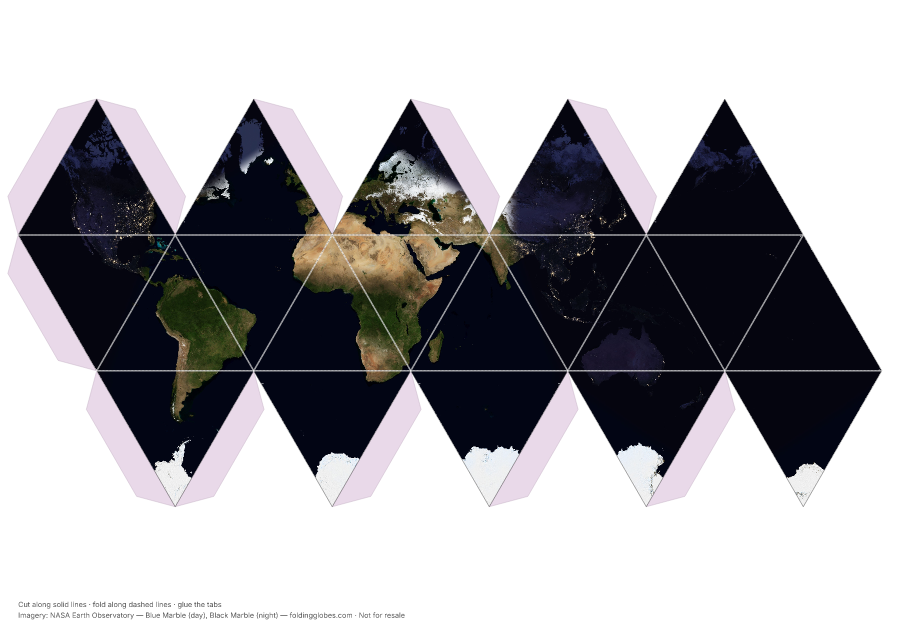
One instant, whole planet: noon over the Prime Meridian in January — Antarctica in round-the-clock sun while the Americas sleep under city lights.
Drag to spin — this is what yours looks like folded.
About this globe
Half the planet is always in daylight and half in darkness — this globe freezes one such instant: noon on the Prime Meridian in mid-January. The day side is NASA's Blue Marble January imagery, the night side is Black Marble city lights, and the line between them is the terminator, computed for the real position of the January sun.
Because it's January, the sun stands south of the equator: Antarctica is lit around the clock while the Arctic never sees the sun at all. Fold its twin, Noon in July, and watch the midnight sun swap poles.
How the data was captured
The day half is MODIS satellite imagery from January passes (Blue Marble); the night half is VIIRS city lights (Black Marble). The dividing line isn't photographed at all — it's the computed position of the sun at noon UTC in mid-January.
Imagery: NASA Earth Observatory — Blue Marble (day), Black Marble (night) →
Download free — pick your paper size
Print at 100% scale. Cut along solid lines, fold along dashed lines, glue the tabs. Your PDF can take up to a minute to prepare — hang tight after clicking.
In the US? Print the A4 file and choose “fit to page” — it scales cleanly onto Letter paper.
Sharing this globe?
Free for personal use, classrooms, and gifts — not for resale. If you post it on your site or share it online, please credit Folding Globes with a link. Copy-paste blurb:
"Noon in January" folding paper globe — free from Folding Globes, https://foldingglobes.com/globes/noon-in-january · Imagery: NASA Earth Observatory — Blue Marble (day), Black Marble (night)
Make it yours
Every paid shape also lets you pin your own places on the map.