How Folding Globes Work
Every globe here starts as open scientific data — satellite mosaics, seafloor relief, earthquake catalogs — and ends as a sheet of paper you cut, fold, and glue into a planet. Here’s the whole trick.
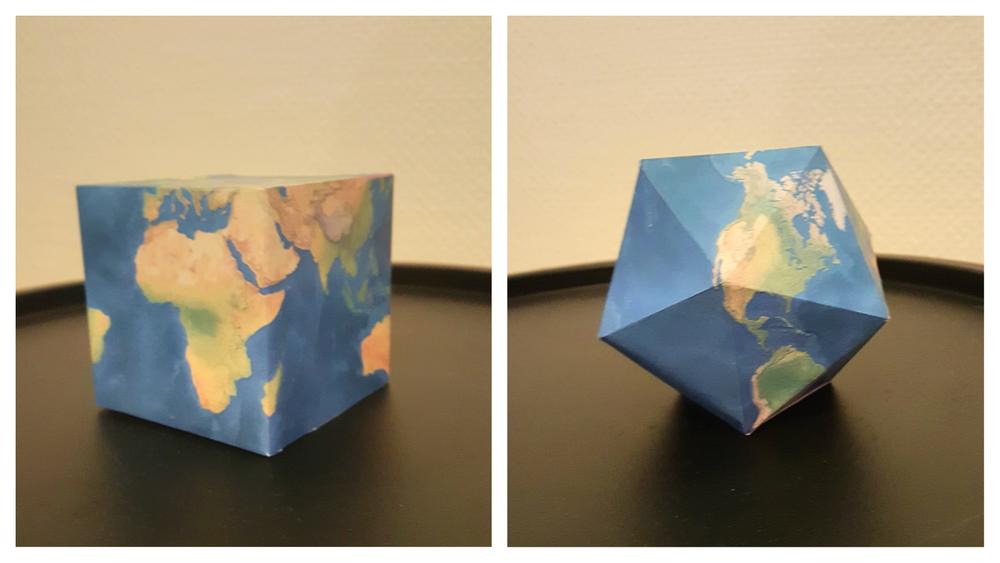
Drag to spin — a folded icosahedron globe.
You can’t flatten a sphere
Every flat map lies a little. A sphere refuses to lie flat, so a wall map has to stretch something — Mercator famously balloons Greenland to the size of Africa. Cartographers have argued about the least-bad stretch for five hundred years.
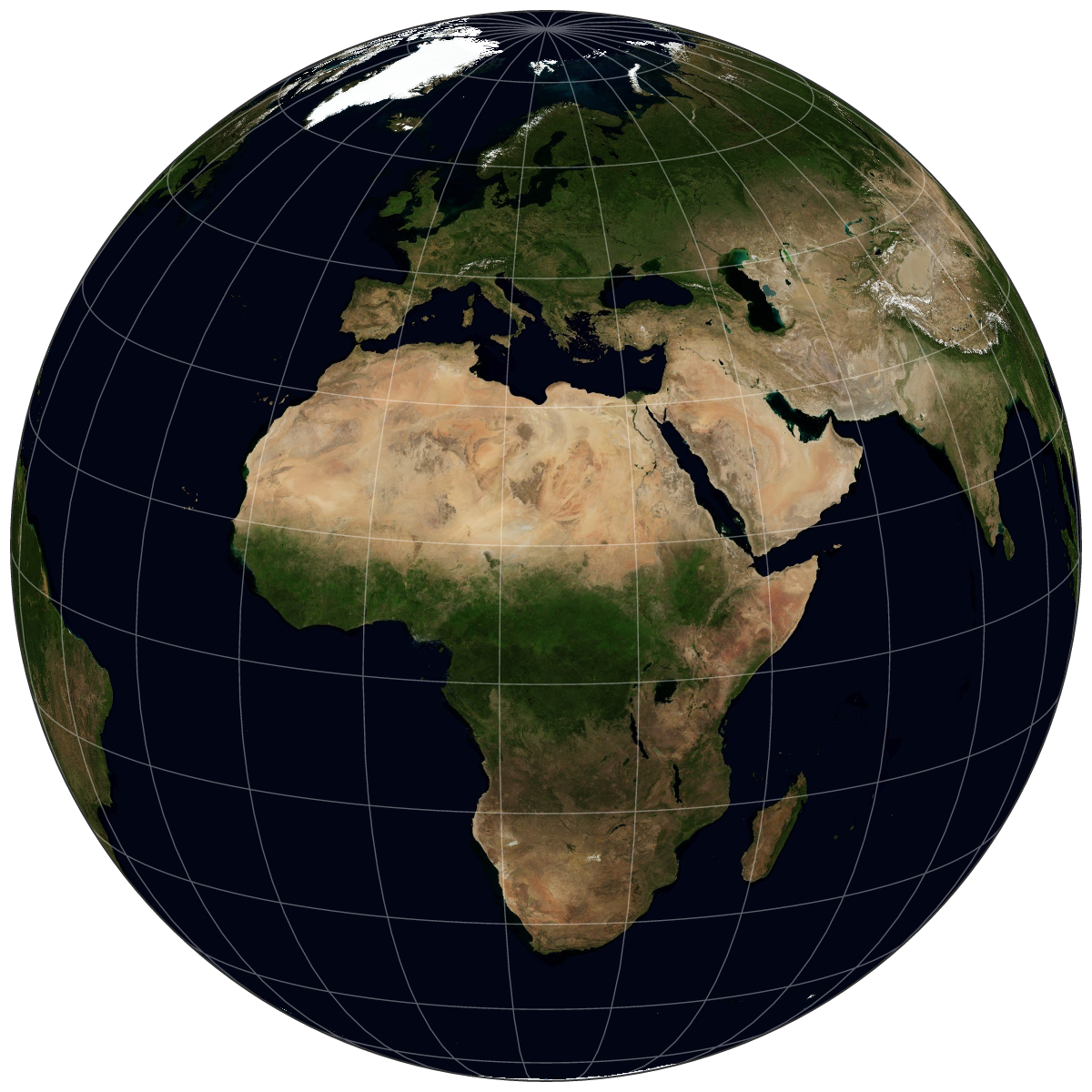
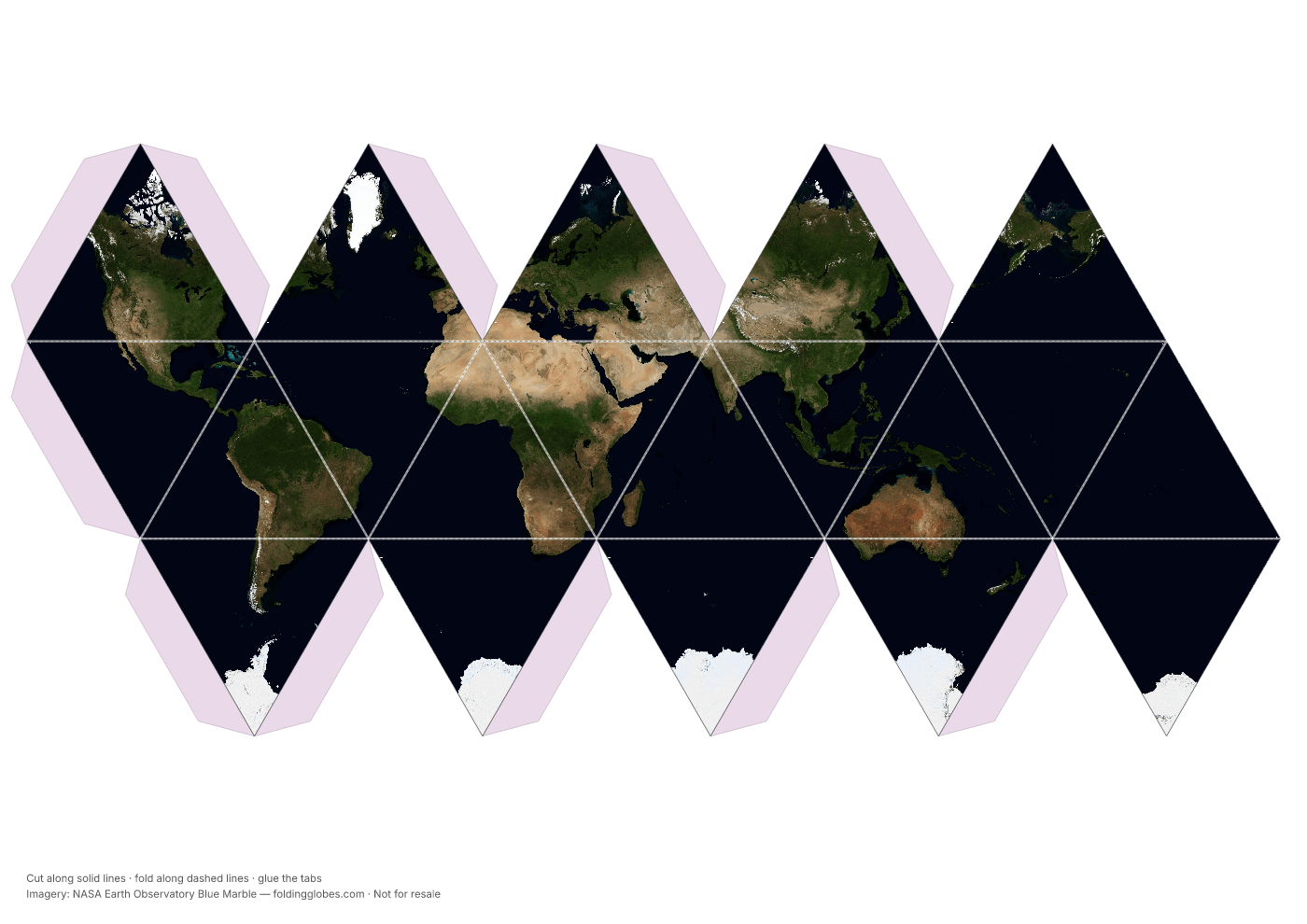
A folding globe sidesteps the argument. Instead of flattening the whole planet onto one rectangle, it splits the sphere into a handful of faces — twenty triangles for the icosahedron above — and gives each face its own tiny map projection, centered on that face. Nothing is ever projected far from home, so the distortion on any single face stays too small to notice.
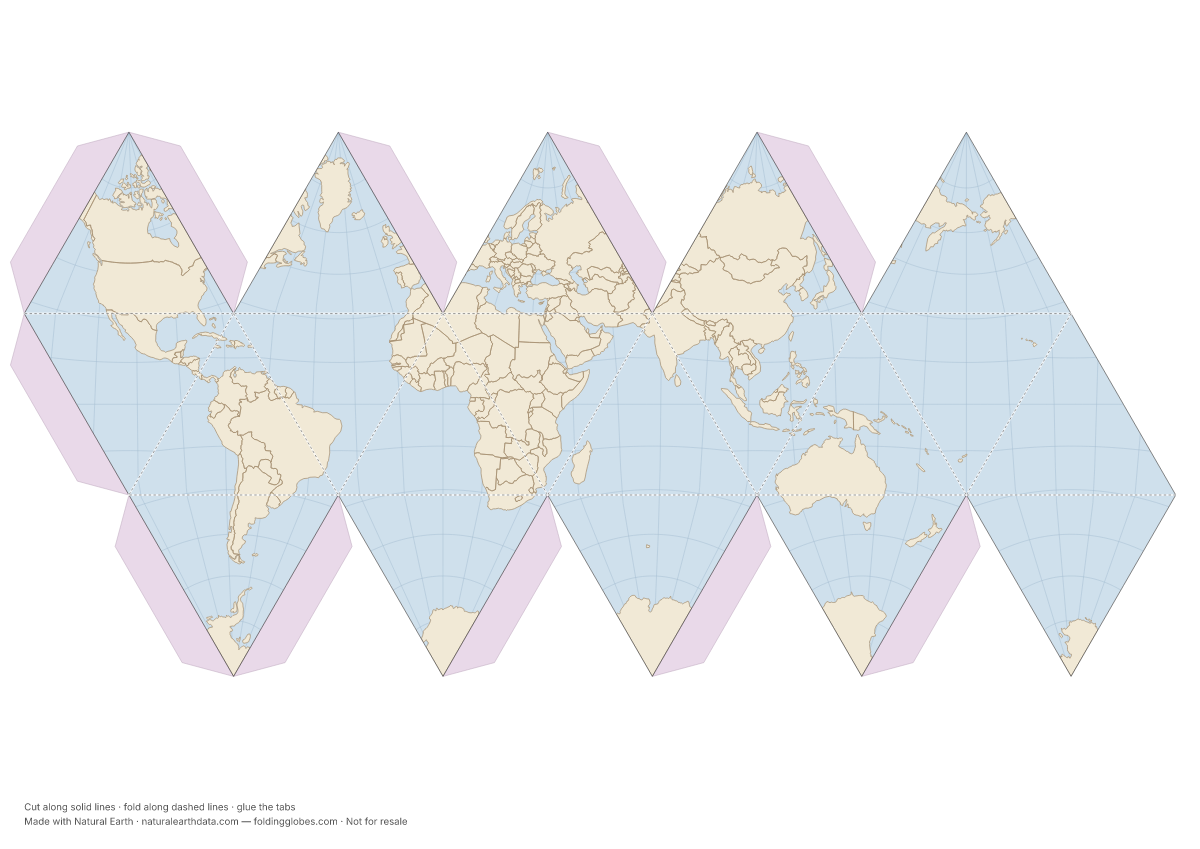
Look closely at the unfolded net: the grid lines curve gently within each triangle. That’s the projection quietly doing its work — every face is a genuine piece of curved Earth laid flat, not a slice chopped out of a rectangular map. Fold the faces back along their shared edges and the sphere reassembles itself.
The shapes
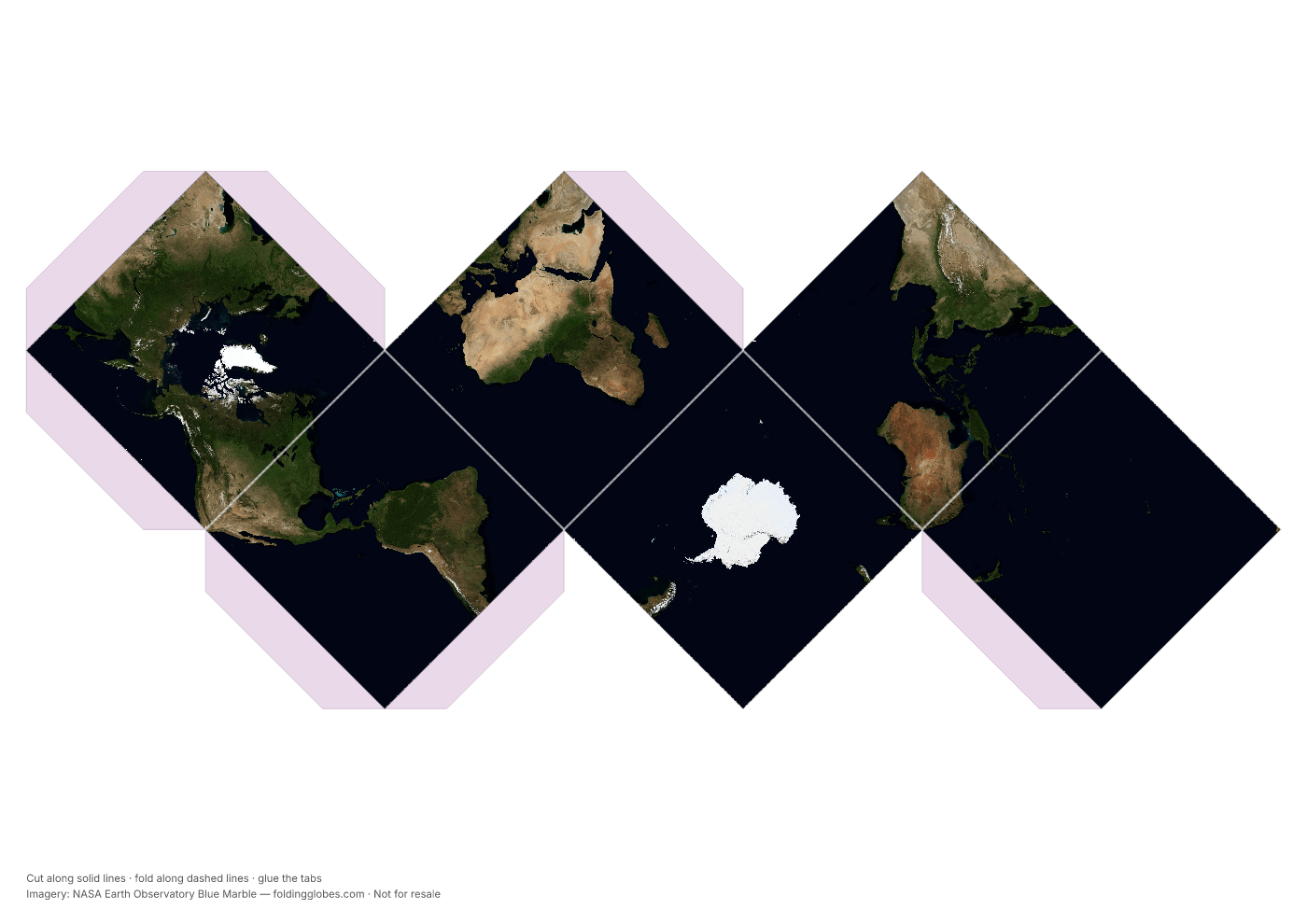
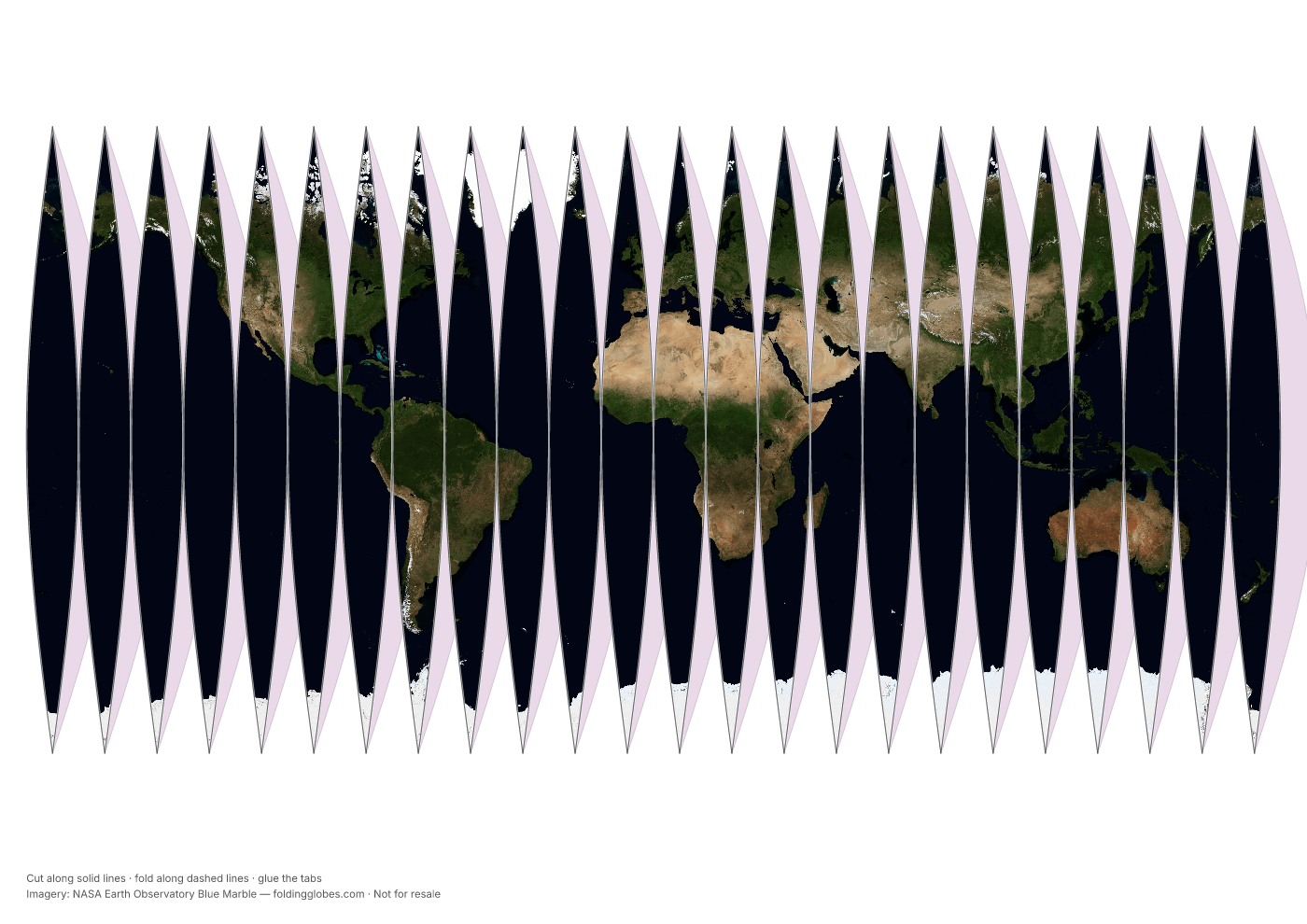
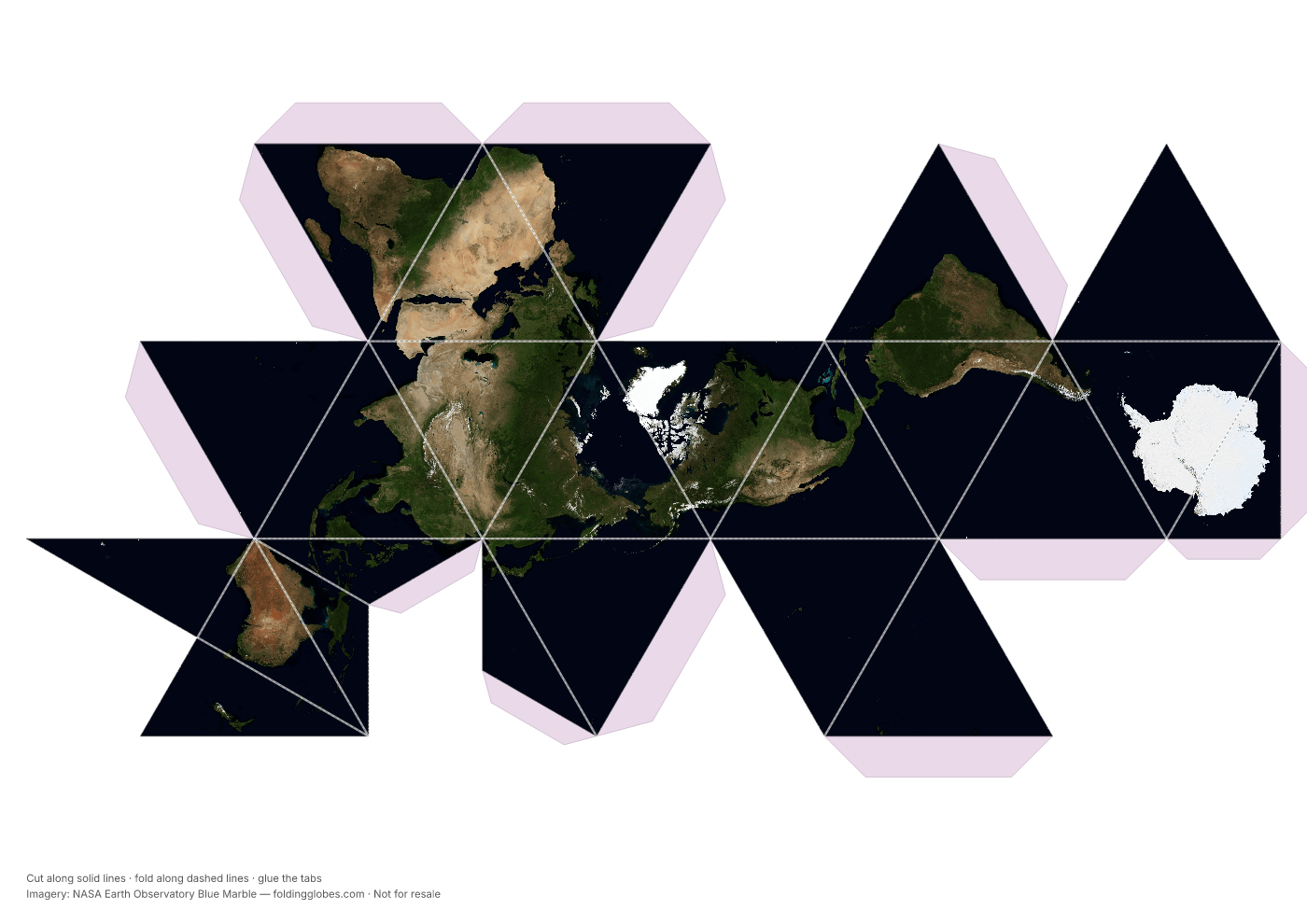
The icosahedron is the workhorse — twenty faces, quick to fold, honest everywhere. From there the family grows: the other Platonic solids down to the four-faced tetrahedron, classic gores cut the way a seventeenth-century globemaker would, and two cartographic showpieces — the Airocean projection, which unfolds the continents almost unbroken, and the Cahill–Keyes M. See them all on the shapes page.
Print, cut, fold, glue
- Print at 100% scale on A4 or A3 — no “shrink to fit”. In the US, print the A4 file and choose “fit to page” — it scales cleanly onto Letter paper.
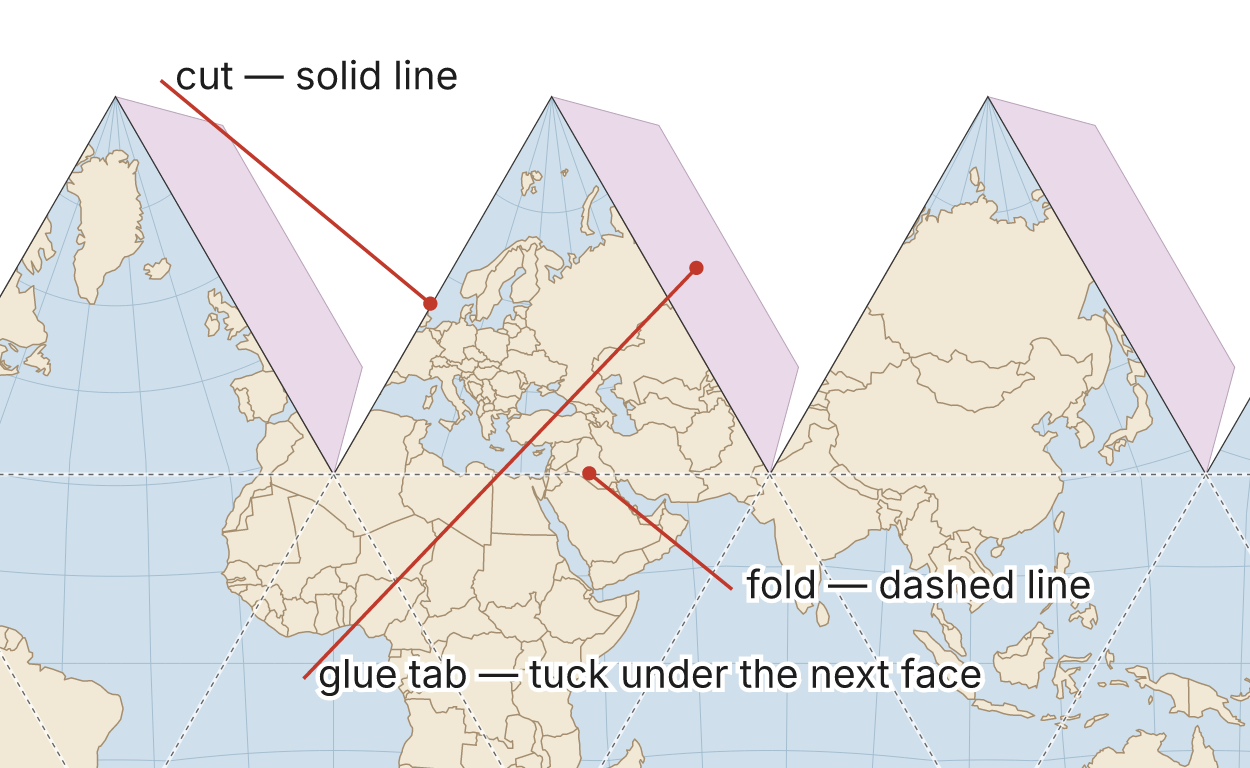
- Cut along the solid dark lines. Everything outside them is scrap.
- Fold along the dashed lines. On dark artwork the dashes sit on a faint white casing so you can still find them. Score first with an empty ballpoint pen if you want razor-sharp edges.
- Glue the lilac tabs and tuck each one under its neighboring face. Work your way around; the last face is the fiddly one — patience, then pride.
Ordinary printer paper works fine. 160–200 gsm card folds crisper and survives desks, backpacks, and classrooms. Most globes take about twenty minutes.